Point-of-Use vs Whole-Home Water Filtration: Which One Fits Your Home?
The best location for water treatment depends on what you are trying to address, where the water will be used, and how much flow the system must handle.
For southeast Wisconsin homeowners, that decision may look different for municipal water, a private well, a drinking-water concern, or a condition affecting plumbing and fixtures throughout the home.
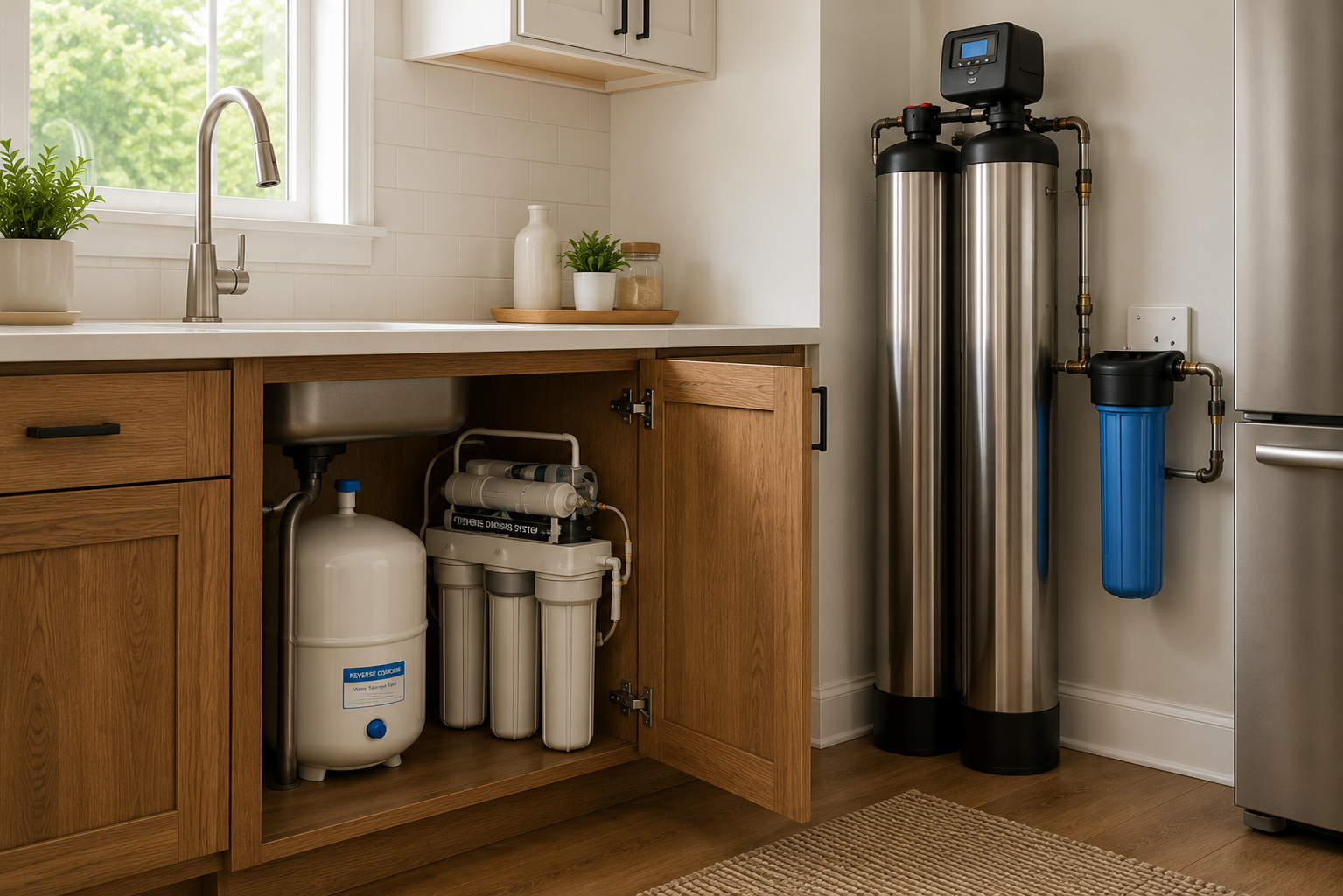
Point-of-use treatment serves a specific location, usually the kitchen sink or another drinking-water tap. Point-of-entry treatment, often called whole-home treatment, is installed where water enters the building and treats most or all water before it travels through the home's plumbing.
Neither approach is automatically superior. The correct choice begins with the water source, test results, the condition being addressed, the desired service flow, and the manufacturer's certified performance claims.
What point-of-use filtration does well
Point-of-use systems concentrate treatment on water used for drinking and cooking. Common formats include under-sink filters, faucet-mounted filters, countertop systems, refrigerator filters, and reverse-osmosis systems.
Focused treatment
Because the system treats a smaller volume, it can be an efficient way to target drinking-water concerns without treating water used for toilets, laundry, or outdoor use.
Lower entry cost
Many point-of-use systems have a lower initial cost than whole-home equipment, although cartridge replacement and long-term maintenance still matter.
A useful final barrier
A properly selected system can provide additional treatment immediately before consumption, including after water has traveled through municipal distribution lines and household plumbing.
Certification-specific selection
The product should be independently certified for the specific reduction claim you need. A general certification mark does not mean every contaminant is covered.
When whole-home treatment makes more sense
Whole-home treatment is appropriate when a water condition affects many fixtures, appliances, bathing, laundry, plumbing, or the overall usability of water throughout the house.
Examples may include sediment, iron, manganese, hardness, objectionable taste or odor throughout the home, or another verified condition that requires treatment before water is distributed.
System design must account for peak flow, pressure loss, media capacity, backwashing or regeneration requirements, wastewater discharge, and maintenance.
A side-by-side decision guide
| Question | Point-of-use may fit | Whole-home may fit |
|---|---|---|
| Where is the concern noticed? | Mainly at the drinking-water tap | Across showers, fixtures, laundry, appliances, or plumbing |
| How much water needs treatment? | Drinking and cooking volumes | Most or all household water |
| Typical examples | Targeted taste, odor, lead, PFAS, or dissolved contaminant reduction when supported by certification | Hardness, sediment, iron, manganese, or broad aesthetic concerns |
| Primary design consideration | Certified reduction performance and cartridge life | Flow rate, pressure loss, capacity, drainage, and service requirements |
| Maintenance | Filter or membrane replacement at the use point | Media replacement, backwashing, regeneration, disinfection, or other scheduled service depending on the technology |
Sometimes the right answer is both
A well-designed home may use a treatment train: multiple technologies arranged in sequence so each stage performs a specific job.
For example, whole-home equipment may address sediment, iron, or hardness, while a certified point-of-use system provides additional treatment for drinking and cooking water.
This layered approach can protect downstream equipment and focus higher-level treatment where it provides the most value. However, combining equipment without understanding the water chemistry can create unnecessary cost or interfere with performance.
Pretreatment, flow, pressure, and maintenance should be considered as one system rather than as isolated products.
Municipal water and private wells require different starting questions
Municipal water
Start with the utility's annual Consumer Confidence Report, any current notices, and the condition of the home's plumbing.
Municipal treatment provides regulated treatment at the community level, but homeowners may still choose additional treatment for a specific concern, taste preference, or final barrier at the tap.
Private well water
Private wells are the homeowner's responsibility. Testing should guide treatment selection, and the system may need to address naturally occurring minerals, agricultural influences, microbial concerns, or local geological conditions.
A clear glass of water is not a substitute for laboratory testing.
Five questions to answer before buying equipment
- What is the water source? Municipal surface water, municipal groundwater, and a private well can present different considerations.
- What has testing or the utility report identified? Choose treatment for evidence, not assumptions.
- Where does the concern matter? Is it limited to drinking water, or does it affect the entire home?
- Is the product certified for the exact reduction claim? Review the certification listing and product performance data sheet.
- Can the system be maintained correctly? Filters that are not replaced and systems that are not serviced may not perform as intended.
Work with a WQA Certified Water Specialist
Healthy Water Solutions LLC uses an education-first process to review your water source, concerns, available testing, treatment goals, and practical installation needs.
The goal is not to force every home into the same system. It is to help you choose the right treatment location and technology for your actual water.
Frequently asked questions
Is whole-home filtration always better?
No. Whole-home equipment treats more water, but that can add cost, maintenance, pressure loss, and design requirements. If the concern is limited to drinking and cooking water, point-of-use treatment may be more practical.
Can one filter remove everything?
No single treatment technology is ideal for every contaminant or water condition. Review certified reduction claims and choose a system based on testing, source-water characteristics, and intended use.
Do certified products remove every contaminant listed under a standard?
No. Certification standards establish testing requirements, but individual products are certified for specific claims. Always verify the exact reduction claims in the certification listing and product performance data sheet.
Can point-of-use and whole-home systems be combined?
Yes. A treatment train can use whole-home treatment for broad conditions and point-of-use treatment for drinking water. The stages should be designed to work together.
Not sure where your water treatment belongs?
Book a True Health Strategy Call to review your water source, concerns, goals, and the most practical next step for your home.
Book a True Health Strategy Call Explore Water TestingReferences and further reading
- U.S. Environmental Protection Agency, WaterSense Guide to Selecting Water Treatment Systems .
- Centers for Disease Control and Prevention, About Choosing Home Water Filters .
- Centers for Disease Control and Prevention, About Home Water Treatment Systems .
- NSF, NSF Standards for Water Treatment Systems .
- NSF, Certified Drinking Water Treatment Units Database .
This article is educational and does not replace laboratory testing, professional system design, utility guidance, or public-health instructions. Treatment performance depends on source-water conditions, system sizing, installation, maintenance, and verified certification claims.